
Key Takeaways
- Lower back pain is one of the most common reasons Australians visit a GP — most episodes settle within 4 to 6 weeks with the right movement plan and pain management.
- Early physiotherapy at MediPharm Prestons can speed recovery, reduce time off work and lower the chance of pain becoming chronic.
- If your back pain comes with leg weakness, numbness in the groin, or loss of bladder/bowel control, see a GP urgently — these are red flags that need same-day assessment.
Lower Back Pain in Prestons: Why It Hurts and What You Can Do About It
If you’ve ever bent down to lift a shopping bag, stood up after a long drive home along the M5, or rolled out of bed only to feel a sudden, gripping pain through your lower back — you’re not alone. Lower back pain affects roughly four in five Australians at some point in their lives, and it’s one of the leading reasons patients book in to see our allied-health team at MediPharm in Prestons, NSW.
The good news? Most lower back pain isn’t dangerous, doesn’t need a scan, and responds extremely well to early, evidence-based physiotherapy. The harder news? When it’s left untreated — or when people are told to simply “rest” — pain can drag on for months, change how you move, and start to affect work, sleep and mood. This guide walks you through what’s actually causing your back pain, the red flags every Australian adult should know, and what a session with a Prestons physio looks like in practice.
Common Causes of Lower Back Pain
Lower back pain is rarely caused by one single injury. In most patients we see at MediPharm, it’s a combination of accumulated load (long hours sitting, repetitive lifting, poor sleep posture) and a single tipping-point movement that brings everything to the surface. The most common patterns we treat include:
- Mechanical / non-specific low back pain — by far the most common. Muscles, joints, ligaments and discs are all interconnected; when one is overloaded, the whole region can become painful and stiff.
- Muscle strain — typically follows a lift, twist or sudden movement. Pain is usually one-sided and worse with bending or rotating.
- Lumbar disc irritation — pain that may radiate into the buttock or down the leg (often called sciatica). Frequently worse with sitting, coughing or sneezing.
- Facet joint pain — small joints either side of the spine; pain is usually felt across the lower back and worsens with extension (bending backward) or standing too long.
- SI (sacroiliac) joint dysfunction — common post-pregnancy and in people who sit asymmetrically (legs crossed, one hip dropped).
- Postural / desk-related strain — especially in office and hybrid workers around Liverpool, NSW and the broader South-West Sydney corridor.
Red Flags: When Lower Back Pain Needs a GP Right Away
Most lower back pain is safe to treat with physiotherapy. But there is a small group of “red flag” symptoms that need urgent medical assessment before any hands-on therapy. Book in with one of our Prestons GPs the same day — or present to your nearest Emergency Department — if you experience any of the following:
- New numbness in the inner thighs, groin or saddle area (the part of your body that would touch a bicycle seat).
- Loss of bladder or bowel control, or difficulty starting urination.
- Sudden, significant weakness in one or both legs (foot drop, knee giving way).
- Unexplained weight loss alongside the back pain.
- A history of cancer, recent infection or unexplained fevers with the back pain.
- Back pain following significant trauma — a fall, vehicle accident, sporting collision.
These are uncommon, but missing them matters. Our GPs and physiotherapists work in the same building, so if anything is flagged in your physio assessment, you can usually be reviewed by a doctor on the same visit.
What a Physio Session at MediPharm Looks Like
A first physiotherapy appointment at our Prestons clinic typically runs for 45 minutes and is broken into four parts. Knowing what to expect tends to take the edge off if you’ve never seen a physio before.
1. The Conversation (10–15 minutes)
Your physiotherapist asks about how the pain started, what makes it better or worse, your sleep, your job, your sport, your medications and your goals. The pattern of your symptoms is often more diagnostic than any scan — most lower back pain does not require an MRI or X-ray in the first six weeks.
2. The Physical Assessment
We’ll watch how you walk, bend, squat, and rotate. We’ll test the strength of your hip, glute and core muscles, the flexibility of your hamstrings and hip flexors, and the mobility of each segment of your lumbar spine. We also screen the relevant nerves with a simple neurological exam — sensation, reflexes and power in the legs.
3. The Explanation
This is the part patients tell us is the most valuable. Your physio will explain what’s actually irritated, what is not damaged (most spines are far more resilient than people think), and a realistic recovery timeline. Catastrophic language — “crumbling disc”, “wear and tear”, “bone on bone” — has been shown to worsen back pain outcomes, so we replace it with evidence-based, plain-English explanations.
4. The Plan
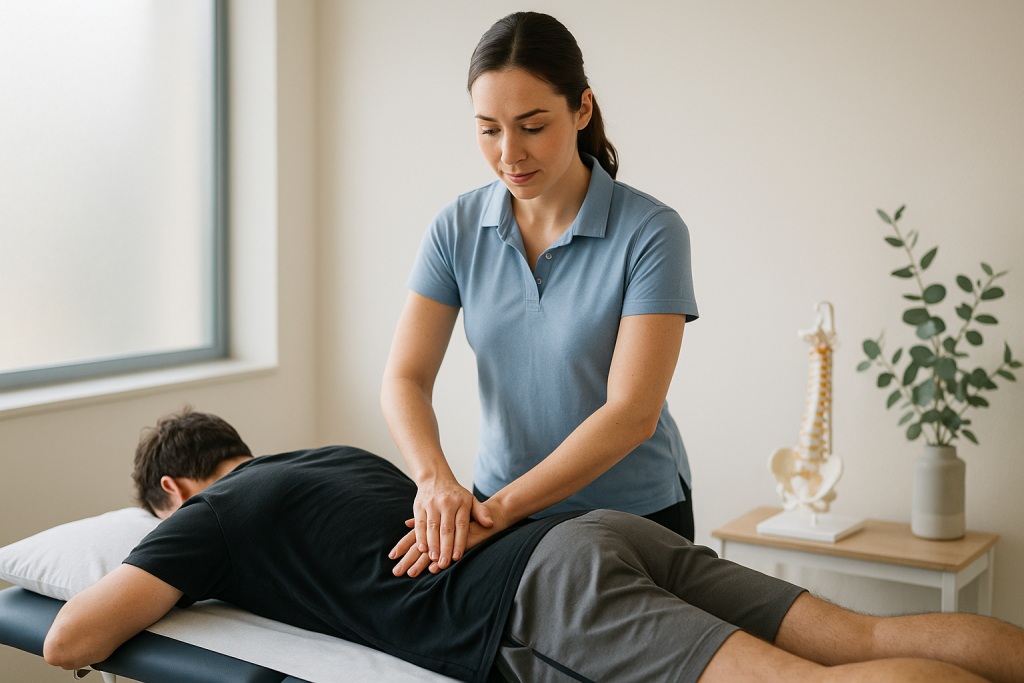
You leave with a clear written plan: usually a combination of hands-on treatment (soft-tissue work, joint mobilisation, dry needling where appropriate), 3 to 5 specific exercises to do at home, and clear guidance on what’s safe to do at work and in the gym while you recover. Most patients with mechanical low back pain feel meaningful improvement within 3 to 4 sessions.
What You Can Do Right Now (Before Your Appointment)
If you’re waiting on a physio appointment — or your pain has just started — these are the safest, most evidence-supported things to do in the first 72 hours:
- Keep moving gently. Old advice was “bed rest for a week” — current evidence is very clear that prolonged rest makes back pain worse. Walk for 5 to 10 minutes every couple of hours.
- Use heat, not ice. For non-traumatic back pain, a heat pack or warm shower across the lower back for 15 to 20 minutes can reduce muscle guarding.
- Sleep on your side with a pillow between your knees, or on your back with a pillow under your knees. Avoid stomach-sleeping while symptoms are sharp.
- Avoid prolonged sitting. If you work at a desk, stand up every 30 minutes — even a one-minute reset helps.
- Simple over-the-counter pain relief (paracetamol, ibuprofen if no contraindications) can help you stay active. Speak to your GP or pharmacist if you’re unsure.
What to avoid in the first 72 hours: heavy lifting, deep stretching of a painful area, sit-ups, and any movement that produces sharp shooting pain down the leg.
How a Physio Plan Reduces the Risk of Chronic Back Pain
The single biggest risk factor for chronic back pain isn’t a disc bulge or a “weak core” — it’s a previous episode of back pain that wasn’t properly rehabilitated. Each new episode adds the brain’s protective memory of pain, which can amplify symptoms next time. That’s why early physiotherapy matters: the goal isn’t just to take the pain away this week, but to build the strength, mobility and movement confidence that stops it returning in six months.
Our physiotherapists work alongside your MediPharm GP on this. If you need imaging, anti-inflammatories, or a GP Management Plan for chronic pain, that conversation happens in the same building — no separate referrals, no extra waiting rooms.
Booking a Physio Appointment in Prestons, NSW
Physiotherapy at MediPharm is available to everyone — private patients, those with private health insurance (we offer HICAPS on-the-spot rebates), workers with WorkCover NSW claims, motor-accident (CTP/SIRA) claims, DVA, and patients with a GP-issued Chronic Disease Management (CDM/EPC) plan for partial Medicare rebates on up to five visits per calendar year.
If you’re not sure which option applies to you, our reception team is happy to talk you through it before you book. We also welcome walk-in enquiries — pop in any weekday at 9/2 Joadja Road, Prestons, NSW 2170, or browse our full allied-health services.
Don’t let back pain wait
Book a physio appointment at MediPharm Prestons
Same-week appointments. HICAPS on the spot. GP and physio under one roof.