It’s one of the most common reasons people put off a skin check: “I feel fine. Nothing looks unusual. I’ll book one when something actually changes.” It is a completely understandable line of thinking – but in the context of skin cancer in Australia, it is also one of the most dangerous.
The short answer is yes. You need a skin check even when you have no symptoms. And understanding why is important for anyone living in south-west Sydney – a region where outdoor lifestyles, sun exposure, and a diverse range of skin types all shape individual risk in different ways.
This article explains what a skin check actually is, why the absence of symptoms is not a reason to skip one, who should be getting checked and how often, and how to access skin checks at MediPharm – conveniently located to serve residents across Prestons, Hoxton Park, Hinchinbrook, Green Valley, Wetherill Park, Bonnyrigg, Casula, Edmondson Park, Liverpool, Middleton Grange, Carnes Hill, Cecil Hills, and Austral.
Skin Cancer Rarely Hurts – and That Is Exactly the Problem
Skin cancers are much more frequently seen than felt. In the early stages, most skin cancers cause no pain, no itching, no discomfort, and no obvious alarm signal. A basal cell carcinoma (BCC) – the most common type of skin cancer in Australia – can appear as a small pale or pearly spot that remains unchanged for months. A squamous cell carcinoma (SCC) may look like a rough, scaly patch that resembles dry skin. And early-stage melanoma, the most serious type, can be visually indistinguishable from an ordinary mole to the untrained eye.
This is precisely why waiting for symptoms is not a reliable strategy. By the time a skin cancer causes pain, bleeding, or obvious visible change, it has often had time to grow, deepen, or in some cases begin to spread. Early detection – finding a change before it produces symptoms – is what makes treatment simpler, less invasive, and more effective.
The Royal Australian College of General Practitioners (RACGP) defines a skin check as a comprehensive assessment and examination of an asymptomatic patient for any evidence of skin cancer. The word asymptomatic is built into the clinical definition itself. Skin checks are, by design, intended for people who feel and look completely fine.
Australia’s Skin Cancer Context – Why Where You Live Matters
Australia has among the highest rates of skin cancer in the world. Approximately two in three Australians develop some form of skin cancer during their lifetime, and around 2,000 Australians die from it each year. The primary driver is ultraviolet (UV) radiation from the sun – and Australia’s climate means UV exposure is intense, year-round, and largely unavoidable.
For residents of south-west Sydney – including those seeking Prestons skin checks, Hoxton Park skin checks, Hinchinbrook skin checks, Green Valley skin checks, and across the surrounding suburbs – the risk is the same as for any other Australian community. Outdoor work, sport, gardening, school runs, weekend activities: all of these contribute to cumulative sun exposure over a lifetime.
It is also worth noting that skin cancer does not only affect fair-skinned individuals. While lighter skin types are at higher statistical risk due to lower melanin levels, people with olive, brown, or dark skin can and do develop skin cancer – and are sometimes diagnosed later because the assumption of lower risk delays investigation. A professional skin check assesses every patient as an individual, regardless of skin tone.
Why Self-Checking Is Not Enough on Its Own
Self-examination of the skin is encouraged and worthwhile – but it has significant limitations. Most people cannot see large portions of their own body clearly. The scalp, back, backs of the legs, behind the ears, under the nails, between the toes, and the soles of the feet are all areas where skin cancers can develop and go unnoticed for an extended period.
Beyond visibility, most people do not have the training to recognise what they are looking for. An early BCC may look like a small pimple that does not heal. An early melanoma may look like a freckle that has been there for years. Without clinical knowledge and the right tools – specifically a dermatoscope, which magnifies and illuminates skin structures invisible to the naked eye – distinguishing between a harmless mole and something that warrants further investigation is genuinely difficult.
A GP-conducted skin check brings both the clinical knowledge and the equipment needed to assess your skin systematically, from head to toe, including areas you cannot see yourself. Spots that appear harmless to the naked eye can appear quite different under dermoscopy – and that difference matters.
Who Should Be Getting Skin Checks – and How Often?
The straightforward answer is that regular skin checks are recommended for all Australian adults. However, the recommended frequency varies depending on individual risk factors. Understanding where you sit on the risk spectrum helps you and your GP decide how often to schedule a check.
Lower Risk – Annual or Biennial Checks
If you do not have specific risk factors for skin cancer and have not previously been diagnosed with skin cancer, a professional skin check every one to two years is a reasonable starting point. Your GP can advise whether your individual circumstances call for something more or less frequent.
Higher Risk – More Frequent Checks
More frequent checks – often every six to twelve months – are commonly recommended for people with one or more of the following risk factors:
- A personal history of skin cancer or precancerous skin changes (such as solar keratoses)
- A family history of melanoma or other skin cancers
- Fair skin that burns easily, particularly skin type I or II
- Red or blonde hair with light-coloured eyes
- A high number of moles (particularly more than 50 moles on the body)
- A history of significant sunburn, especially in childhood
- History of solarium or sunbed use
- Outdoor occupation or lifestyle with high cumulative UV exposure
- A weakened immune system – from conditions such as leukaemia, lymphoma, or use of immunosuppressive medications following organ transplant
If you are unsure which category applies to you, your GP can help assess your risk during a routine consultation or as part of your skin check appointment. Residents across the south-west Sydney area – including those looking for Casula skin checks, Liverpool skin checks, Wetherill Park skin checks, or Bonnyrigg skin checks – can discuss their individual risk profile during a visit to MediPharm.
What About Age – When Should You Start?
There is no single set age at which skin checks become necessary, but the general guidance is that starting in your twenties is sensible for most Australians. Melanoma is the most frequently diagnosed cancer in Australians aged 20 to 39, which reflects the reality that sun damage from childhood and adolescence can manifest in skin cancer at a younger age than many people expect.
For those who grew up in Australia, spent significant time outdoors, or have any of the higher-risk characteristics listed above, beginning regular professional skin checks in early adulthood – rather than waiting until middle age – is the more protective approach.
What Actually Happens During a GP Skin Check?
Many people put off skin checks partly because they are not sure what to expect. The reality is that a professional skin check at a GP clinic is a straightforward, non-invasive appointment that typically takes between fifteen and thirty minutes.
Before the Appointment
To prepare for your skin check, there are a few simple steps that will help your GP conduct a thorough assessment:
- Remove nail polish from fingernails and toenails, as skin changes can occur beneath and around nails
- Avoid fake tan, which can mask the natural colour of moles and spots
- Wear loose, comfortable clothing that is easy to remove
- Wear your hair loose to allow the scalp to be examined
- Remove makeup where possible so that facial skin can be assessed clearly
- Make a note of any spots or areas that have changed, or that you are uncertain about, to mention during your appointment
During the Appointment
Your GP will begin by asking about your personal and family history of skin cancer, your skin type, your history of sun exposure, and any current medications. This provides the context for assessing your individual risk.
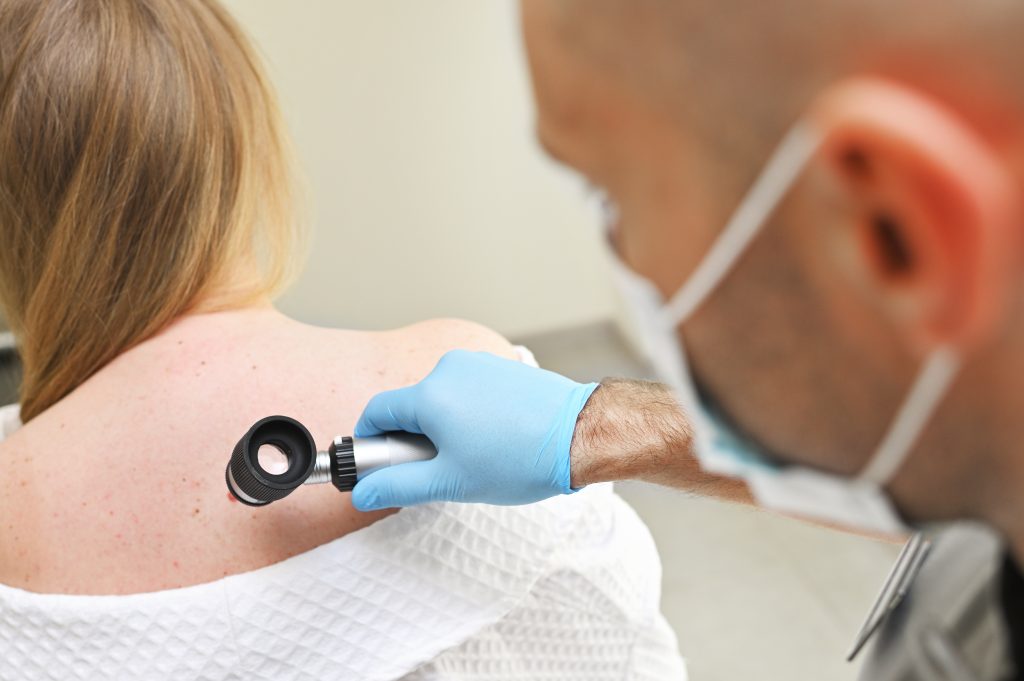
A full skin examination then follows, covering the entire body from head to toe – including the scalp, face, neck, chest, back, arms, legs, hands, feet, and between the toes. Areas that are not routinely exposed to the sun are also checked, as skin cancer can develop on any part of the body.
A dermatoscope may be used to examine spots more closely. This handheld device provides magnification and specialised lighting that allows your GP to view the structure of a lesion in far more detail than is possible with the naked eye – supporting more accurate assessment of whether a spot needs monitoring, biopsy, or referral.
After the Appointment
If your GP identifies a lesion of concern, they will discuss the next steps with you. This might involve monitoring the spot with a follow-up appointment in a set period, arranging a biopsy – where a small sample of the lesion is sent to a pathologist for analysis – or referring you to a dermatologist. If no concerning lesions are found, your GP will advise on how often to return for your next check and what to look for in the meantime during self-examination at home.
Importantly, a skin check appointment is also an opportunity to ask questions about your skin health – including how to protect your skin from further UV damage and how to perform effective self-examinations between appointments.
The ABCDE of Melanoma – What to Look for at Home
Between professional skin checks, regular self-examination is an important part of monitoring your skin. Most melanomas are first noticed by the person themselves, their partner, or another family member – which makes self-awareness a genuinely useful tool.
The ABCDE guide is a widely used framework for identifying changes that may warrant prompt medical attention:
- A – Asymmetry: A mole or spot where one half does not match the other
- B – Border: An irregular, uneven, or notched edge rather than a smooth, clearly defined outline
- C – Colour: Variation in colour within a single spot – including shades of brown, black, red, white, or blue
- D – Diameter: A spot larger than approximately 6mm (roughly the size of a pencil eraser), or one that is growing
- E – Evolving: Any spot that is changing in size, shape, colour, or behaviour – including new itching, bleeding, crusting, or elevation
In addition to the ABCDE signs, any sore that does not heal within a few weeks, any new spot that appears after the age of 25, or any spot that simply looks different from the others on your body is worth having assessed by a GP promptly.
The ABCDE guide is a helpful starting point, but it is not infallible – some melanomas, particularly nodular melanoma, do not follow this pattern. This is why professional assessment remains essential alongside self-examination.
Common Reasons People Delay – and Why They Should Not
“I feel fine and nothing looks wrong”
This is the most common reason people delay – and as outlined throughout this article, it reflects a misunderstanding of how skin cancer often presents. Early-stage skin cancers are typically asymptomatic and may look unremarkable. Feeling fine is not the same as being clear.
“I have dark skin so I’m not at risk”
While people with darker skin have more melanin, which provides some natural protection against UV radiation, they are not immune to skin cancer. Certain types of skin cancer, including acral melanoma – which occurs on the palms, soles, and under nails – are less related to UV exposure and affect people of all skin tones. People of all ethnicities benefit from periodic skin assessment.
“I’m too young to worry about skin cancer”
Melanoma is the most commonly diagnosed cancer in Australians aged 20 to 39. Sun damage accumulated during childhood and teenage years contributes to skin cancer risk in early adulthood. Age alone is not a reason to delay a first skin check.
“I don’t know where to go for a skin check”
Skin checks are available through your regular GP – there is no need to visit a specialist clinic as a first step. Residents across south-west Sydney looking for Edmondson Park skin checks, Middleton Grange skin checks, Carnes Hill skin checks, Cecil Hills skin checks, or Austral skin checks can access a professional assessment through MediPharm’s medical practice team, with no specialist referral required for an initial skin check.
“I’m worried about what they might find”
Health anxiety is real and understandable. But the alternative – not knowing – does not make the risk smaller. It simply removes the opportunity to act early. When skin cancer is found at an early stage, it is one of the most treatable forms of cancer. Most early-stage skin cancers can be managed with straightforward procedures. Delayed detection often means more complex treatment.
Protecting Your Skin Between Appointments
A skin check is a point-in-time assessment – it is not a substitute for ongoing sun protection. Between professional checks, your day-to-day habits play a significant role in reducing your overall skin cancer risk.
- Apply SPF 50+ broad-spectrum sunscreen on any skin exposed to the sun, and reapply every two hours when outdoors
- Wear protective clothing including long sleeves, broad-brimmed hats, and UV-protective eyewear when UV levels are high
- Seek shade during peak UV hours, generally between 10am and 3pm in most parts of Australia
- Avoid solarium and sunbed use
- Perform regular self-examinations of your skin – ideally every three months – using a mirror for areas you cannot see directly
- Check your UV index before going outdoors and plan accordingly – when the UV index is 3 or above, sun protection is recommended
Consistent sun protection habits, combined with regular professional skin checks, represent the most effective approach to managing skin cancer risk in the Australian context.
Skin Checks at MediPharm – Serving South-West Sydney
Skin checks are available as part of the general medical services at MediPharm, conveniently located at Hoxton Park Central in Prestons, NSW. The practice serves patients from across the south-west Sydney region, including residents of Prestons, Hoxton Park, Hinchinbrook, Green Valley, Wetherill Park, Bonnyrigg, Casula, Edmondson Park, Liverpool, Middleton Grange, Carnes Hill, Cecil Hills, and Austral.
MediPharm is an AGPAL-accredited medical centre with a team of experienced general practitioners providing personalised, patient-centred care. Whether you are booking your first ever skin check, following up after a previous concern, or looking to establish a regular schedule of skin assessments as part of your preventive health routine, the team at MediPharm is well-placed to assist.
The practice offers extended weekday hours and weekend availability, with bulk billing available for eligible patients. Online booking is available through HealthEngine, making it straightforward to secure an appointment that fits your schedule.
If you are due for a skin check – or simply unsure when you last had one – do not wait for a symptom to appear before making an appointment. Early assessment is the most effective step you can take for your skin health.